MENU
Showcase Project One
Ten Thousand Things JMS Studio
THE ARTIST'S VISION
“In the light of the moon, there is no such thing as a stranger.” Inspired by the haiku of Zen priest Kobayashi Issa, Ten Thousand Things is a cybernetic installation where the rhythm of light is dictated by the phases of the moon. It is a post-human tree: a rock base giving way to a form with hyper-realistic flesh and human hair. The work explores the sublime macrocosm of the evolution of the cosmos birthed through the abject microcosm of technology and the body.


THE PROBLEM STATEMENT
The challenge was to translate an evolving, abstract concept into a reliable, massive-scale physical installation. The artist required a highly iterative design process that integrated organic materials (hair, flesh-mimicking resins) with complex, responsive electronics, all while maintaining the structural integrity required for international transport and public exhibition.
Strategic Execution
sprint goals to maintain momentum & evolving creative objectives
PHASE ONE: Material Discovery & Ideation


I initiated a dual-track research phase to establish a technical foundation for the artist’s ideation. This involved traditional surveying of experimental materials in external fields alongside aggressive "hands-on" testing with thin-set transparent concretes, fibreglass, and silicones. By creating a library of physical test samples, I provided a tangible reality check and a shared “vocabulary” that allowed the artist to accurately differentiate between conceptual "castles in the sky" and viable physical outcomes. This phase allowed the artist to flesh out the brief with more direction, giving me the opportunity to refine the "skin and hair" tactile qualities and identify the best forms to integrate with the lighting.
PHASE TWO: Refinement & Executable Translation


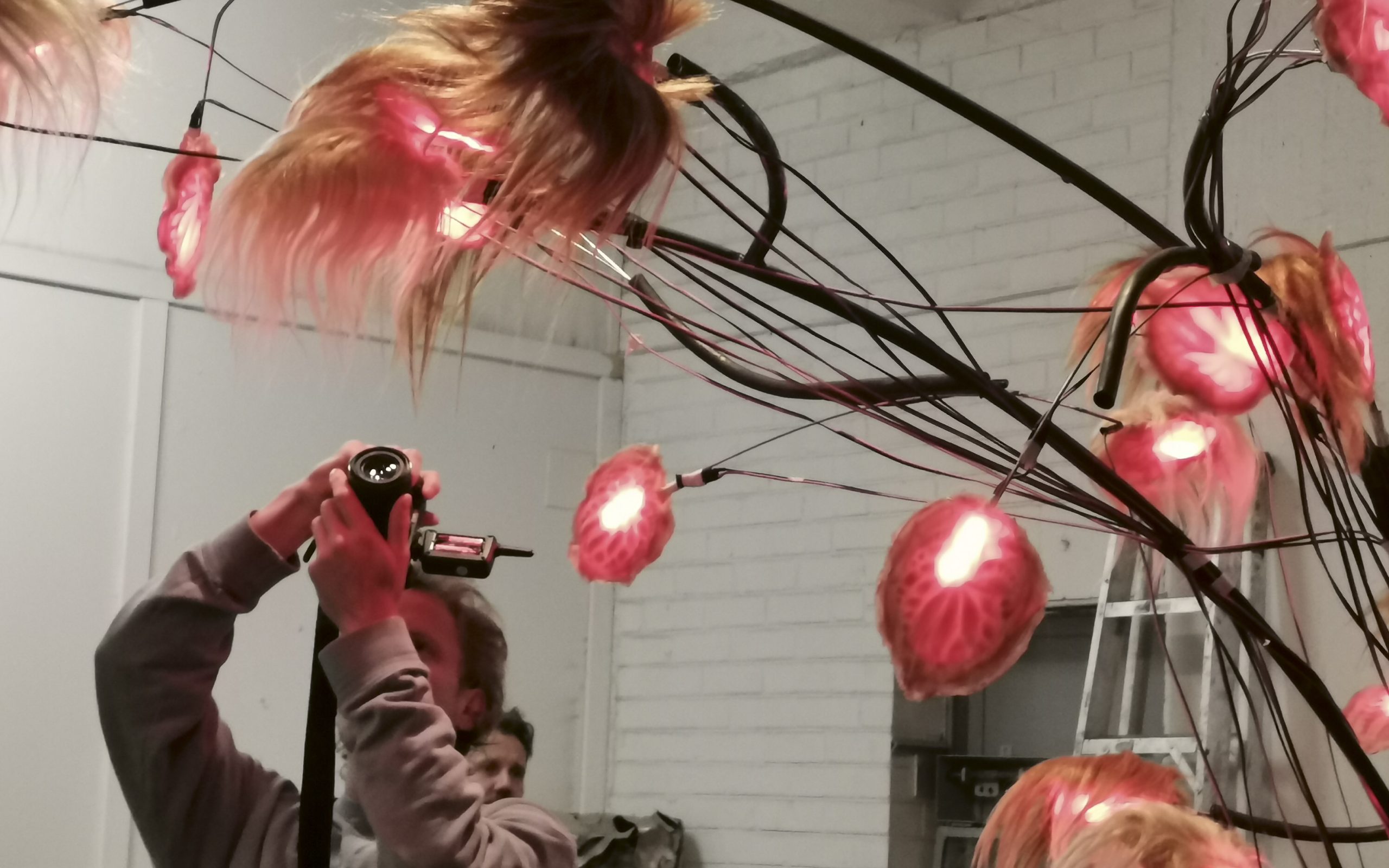
As the material direction narrowed, I shifted focus to the structural integration of organic aesthetics with technical requirements. This phase involved developing the "flesh and hair" tactile qualities while simultaneously designing the internal armatures to hold the organic leaves and house the lighting components. By exploring and subsequently abandoning movement-based mechanics in favour of lighting rhythms, I ensured the structural forms remained sound and focused on the project's core "cybernetic" intent.
PHASE THREE: Integration of expert knowledgeinto project workflow
Recognising that the specific lighting components and programming required absolute precision, I engaged a technical specialist to develop the internal electronics. It is a common "designer’s trap" to believe one should learn every new skill on the fly, but in a high-stakes client environment, I recognised that the margin for error was too slim for self-teaching. By bringing in an expert, I ensured the project’s success. I "over-spec’d" the power supplies and LED infrastructure, ensuring the system remained adaptable to changing programming requirements without needing physical hardware revisions
PHASE FOUR:The Relay Manufacturing System (Agile Production)
To transition a refined but complex concept into an executable project under tight deadlines, I implemented a "staggered relay" manufacturing structure. This allowed for the batch manufacture of locked-down components while simultaneously prototyping and testing unfinished elements. While this approach required high-level risk management regarding final integration, it was the only strategic path that forced decisive, creative commitments and met the demanding delivery schedule.
PHASE FIVE:Technical Resolution & post-production Management
The final stages of fabrication required intensive "pain-point" resolution and adaptive engineering. Because the project’s rapid pace meant some fabrication streams (such as the welding and joinery teams) proceeded without constant oversight during the final climax, I had to manage the resulting integration errors. I led the technical "bridge-building" phase—redesigning components on the fly to correct fitment issues and engineering custom shrouds to conceal complex wiring. This phase showcased my ability to maintain the aesthetic integrity of the work even when resolving unforeseen structural and logistical conflicts.
PERSONAL REFLECTION
"I often describe my role as 'imagining the castles in the sky, then figuring out how to make them float.' This project was the ultimate test of that philosophy."
Executing Ten Thousand Things required high-level multitasking and the ability to act as a "buffer" between abstract creative intent and the hard reality of physics and deadlines. Working in a highly iterative environment taught me the value of establishing a rapport of trust through technical expertise.
My role was multifaceted: I functioned as the lead designer, production manager, and technical consultant. By breaking the "impossible" down into manageable sprints and designing a resilient production system, we were able to ship a high-fidelity, cybernetic installation to Istanbul that pushed the boundaries of material science and responsive design.